Essay on Value of Oxygen and Water for Students and Children
We all know that human beings need a number of things to survive. The most essential two things are surely oxygen and water. These two things are absolutely necessary for mankind. However, what we do not realize is that we are polluting both these things at a very fast rate. If we look at it closely, we’ll see that human activities are causing these two to deplete.

Value of Oxygen
Oxygen is basically a colourless and odourless gas which is a part of several compounds like water as well. Humans along with other mammals require oxygen necessarily. They need it to carry out their daily tasks and smooth functioning of the body.
Even the cells in our body need oxygen to function properly. All the living beings inhale oxygen in their lungs for proper respiration. After that, our cells absorb this gas to distribute it evenly to other cells of the body. Most importantly, oxygen is also stored in our body for emergency use so we can survive critical situations.
Furthermore, we also need oxygen to produce energy which helps in doing our tasks efficiently. For instance, through oxidation, our food and liquid get converted into energy. It is also beneficial in repairing our cells and maintaining our health.
Thus, we must ensure that we get an abundant supply of oxygen from nature. Do not cut down trees and clear out forests. On the contrary, we need to plant more trees. Similarly, do not pollute the air and hamper the oxygen quality. Avoid using personal conveyance and make sure to not leave a carbon footprint.
Get the huge list of more than 500 Essay Topics and Ideas
Value of Water
Water is an essential source for the survival of living beings. It would be an understatement to say that we cannot survive without it. It is made after the amalgamation of oxygen and hydrogen. Just like oxygen, it is also colourless and odourless.
Water is found in abundance on the planet though not all of it is safe for human consumption. We have been using water for centuries now, however, it is limited. It does replenish but that process also takes time which we are not giving it.
Water is equally important as oxygen is for living beings. Each body part even the tissue and cell need water for proper functioning. It helps in regulating the temperature of our body. Moreover, it also enhances the circulation of blood and oxygen in our body.
Furthermore, water is very important for lubricating our joints. Our digestive system also needs water for proper functioning. Moreover, water helps in flushing out the toxins from our body.
Similarly, our brain cells need water for proper functioning. We must drink sufficient amount of water for a healthy life. It will help in keeping you fit and fine for longer life. Thus, we must save water and use it wisely. Do not keep the tap running when not in use. Avoid dumping your waste into water and keep it as clean as possible.
Some FAQs for you
Q.1 Why do living beings need oxygen and water?
A.1 Living beings need oxygen and water to survive and grow. It helps in the smooth functioning of their body. Moreover, it also keeps them healthy and fit.
Q.2 What should we do to conserve water and oxygen?
A.2. Though these resources are very important, they are somewhat limited. We need to conserve them by using them properly. Further, do not waste water and pollute our air. We must plant more trees to get an abundant supply of oxygen.
The oxidation state of oxygen is −2 in almost all known compounds of oxygen. The oxidation state −1 is found in a few compounds such as peroxides. Compounds containing oxygen in other oxidation states are very uncommon: −1⁄2 (superoxides), −1⁄3 (ozonides), 0 (elemental, hypofluorous acid), +1⁄2 (dioxygenyl), +1 (dioxygen difluoride), and +2 (oxygen difluoride).
Oxygen is reactive and will form oxides with all other elements except the noble gases helium, neon, argon and krypton.[1]
Water (H
2O) is the oxide of hydrogen and most familiar oxygen compound. Its bulk properties partly result from the interaction of its component atoms, oxygen and hydrogen, with atoms of nearby water molecules. Hydrogen atoms are covalently bonded to oxygen in a water molecule but also have an additional attraction (about 23.3 kJ·mol−1 per hydrogen atom) to an adjacent oxygen atom in a separate molecule.[2] These hydrogen bonds between water molecules hold them approximately 15% closer than what would be expected in a simple liquid with just Van der Waals forces.[3][4]

2O
3, form when oxygen combines with other elements
Due to its electronegativity, oxygen forms chemical bonds with almost all other free elements at elevated temperatures to give corresponding oxides. However, some elements, such as iron which oxidises to iron oxide, or rust, Fe
2O
3, readily oxidise at standard conditions for temperature and pressure (STP). The surface of metals like aluminium and titanium are oxidized in the presence of air and become coated with a thin film of oxide that passivates the metal and slows further corrosion.[5] So-called noble metals, such as gold and platinum, resist direct chemical combination with oxygen, and substances like gold(III) oxide (Au
2O
3) must be formed by an indirect route.
The alkali metals and alkali earth metals all react spontaneously with oxygen when exposed to dry air to form oxides, and form hydroxides in the presence of oxygen and water. As a result, none of these elements is found in nature as a free metal. Caesium is so reactive with oxygen that it is used as a getter in vacuum tubes. Although solid magnesium reacts slowly with oxygen at STP, it is capable of burning in air, generating very high temperatures, and its metal powder may form explosive mixtures with air.
Oxygen is present as compounds in the atmosphere in trace quantities in the form of carbon dioxide (CO
2) and oxides of nitrogen (NOx). The Earth's crustal rock is composed in large part of oxides of silicon (silica SiO
2, found in granite and sand), aluminium (aluminium oxide Al
2O
3, in bauxite and corundum), iron (iron (III) oxide Fe
2O
3, in hematite and rust) and other oxides of metals.

2)
The rest of the Earth's crust is formed also of oxygen compounds, most importantly calcium carbonate (in limestone) and silicates (in feldspars). Water-soluble silicates in the form of Na
4SiO
4, Na
2SiO
3, and Na
2Si
2O
5 are used as detergents and adhesives.[6]
Peroxides retain some of oxygen's original molecular structure ((−O-O−). White or light yellow sodium peroxide (Na
2O
2) is formed when metallic sodium is burned in oxygen. Each oxygen atom in its peroxide ion may have a full octet of 4 pairs of electrons.[6] Superoxides are a class of compounds that are very similar to peroxides, but with just one unpaired electron for each pair of oxygen atoms (O−
2).[6] These compounds form by oxidation of alkali metals with larger ionic radii (K, Rb, Cs). For example, potassium superoxide (KO
2) is an orange-yellow solid formed when potassium reacts with oxygen.
Hydrogen peroxide (H
2O
2) can be produced by passing a volume of 96% to 98% hydrogen and 2 to 4% oxygen through an electric discharge.[7] A more commercially-viable method is to allow autoxidation of an organic intermediate, 2-ethylanthrahydroquinone dissolved in an organic solvent, to oxidize to H
2O
2 and 2-ethylanthraquinone.[7] The 2-ethylanthraquinone is then reduced and recycled back into the process.
When dissolved in water, many metallic oxide form alkaline solutions, while many oxides of nonmetals form acidic solutions. For example, sodium oxide in solution forms the strong base sodium hydroxide, while phosphorus pentoxide in solution forms phosphoric acid.[7]
Oxygenated anions such as chlorates (ClO−
3), perchlorates (ClO−
4), chromates (CrO2−
4), dichromates (Cr
2O2−
7), permanganates (MnO−
4), and nitrates (NO−
3) are strong oxidizing agents. Oxygen forms heteropoly acids and polyoxometalate ions with tungsten, molybdenum and some other transition metals, such as phosphotungstic acid (H
3PW
12O
40) and octadecamolybdophosphoric acid (H
6P
2Mo
18O
62).
Oxygen can form oxides with heavier noble gases xenon and radon, although this needs indirect methods. Even though no oxides of krypton are known, oxygen is able to form covalent bonds with krypton in an unstable compound Kr(OTeF5)2.
One unexpected oxygen compound is dioxygenyl hexafluoroplatinate, O+
2PtF−
6, discovered in studying the properties of platinum hexafluoride (PtF
6).[8] A change in color when this compound was exposed to atmospheric air suggested that dioxygen was being oxidized (in turn the difficulty of oxidizing oxygen led to the hypothesis that xenon might be oxidized by PtF
6, resulting in discovery of the first xenon compound xenon hexafluoroplatinate Xe+
PtF−
6). The cations of oxygen are formed only in the presence of stronger oxidants than oxygen, which limits them to the action of fluorine and certain fluorine compounds. Simple oxygen fluorides are known.[9]
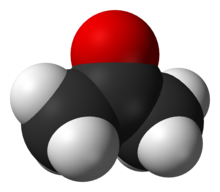
(oxygen is in red, carbon in black and hydrogen in white)
Among the most important classes of organic compounds that contain oxygen are (where "R" is an organic group): alcohol (R-OH); ethers (R-O-R); ketones (R-CO-R); aldehydes (R-CO-H); carboxylic acids (R-COOH); esters (R-COO-R); acid anhydrides (R-CO-O-CO-R); amides (R-C(O)-NR2). There are many important organic solvents that contain oxygen, among which: acetone, methanol, ethanol, isopropanol, furan, THF, diethyl ether, dioxane, ethylacetate, DMF, DMSO, acetic acid, formic acid. Acetone ((CH
3)
2CO) and phenol (C
6H
5OH) are used as feeder materials in the synthesis of many different substances. Other important organic compounds that contain oxygen are: glycerol, formaldehyde, glutaraldehyde, citric acid, acetic anhydride, acetamide, etc. Epoxides are ethers in which the oxygen atom is part of a ring of three atoms.
Oxygen reacts spontaneously with many organic compounds at or below room temperature in a process called autoxidation.[7] Alkaline solutions of pyrogallol, benzene-1,2,3-triol absorb oxygen from the air, and are used in the determination of the atmospheric concentration of oxygen. Most of the organic compounds that contain oxygen are not made by direct action of oxygen. Organic compounds important in industry and commerce are made by direct oxidation of a precursor include:[6]
- Ethylene oxide (used to make the antifreeze ethylene glycol) is obtained by direct oxidation of ethylene:
- C
2H
4 + ½ O
2 + catalyst
———→ C
2H
4O
- C
- Peracetic acid (feeder material for various epoxy compounds) is obtained from acetaldehyde:
- CH
3CHO + O
2 + catalyst
———→ CH
3C(O)-OOH
- CH

The element is found in almost all biomolecules that are important to, or generated by, life. Only a few common complex biomolecules, such as squalene and the carotenes, contain no oxygen. Of the organic compounds with biological relevance, carbohydrates contain the largest proportion by mass of oxygen (about 50%). All fats, fatty acids, amino acids, and proteins contain oxygen (due to the presence of carbonyl groups in these acids and their ester residues). Furthermore, seven of the amino acids which are incorporated into proteins, have oxygen incorporated into their side-chains, as well. Oxygen also occurs in phosphate (PO43−) groups in the biologically important energy-carrying molecules ATP and ADP, in the backbone and the purines (except adenine) and pyrimidines of RNA and DNA, and in bones as calcium phosphate and hydroxylapatite.
- ^ Chemical properties of Oxygen[1], Lenntech. Accessed January 25, 2008. "Oxygen is reactive and will form oxides with all other elements except helium, neon, argon and krypton."
- ^ P. Maksyutenko, T. R. Rizzo, and O. V. Boyarkin (2006). "A direct measurement of the dissociation energy of water", J. Chem. Phys. 125 doi 181101.
- ^ Chaplin, Martin (2008-01-04). "Water Hydrogen Bonding". Retrieved 2008-01-06.
- ^ Also, since oxygen has a higher electronegativity than hydrogen, the charge difference makes it a polar molecule. The interactions between the different dipoles of each molecule cause a net attraction force.
- ^ The aluminium oxide layer can be built to greater thickness by the process of electrolytic anodizing.
- ^ a b c d Cook 1968, p.507
- ^ a b c d Cook 1968, p.506
- ^ Cook 1968, p.505
- ^ Cotton, F. Albert and Wilkinson, Geoffrey (1972). Advanced Inorganic Chemistry: A comprehensive Text. (3rd Edition). New York, London, Sydney, Toronto: Interscience Publications. ISBN 0-471-17560-9

Comments
Post a Comment